
Featheredge Fencing: What You Need, How to Work It Out, and How to Build It Right
- Apr 13
- 4 min read
Featheredge fencing is one of the most common jobs in domestic and light commercial landscaping across Kent - and one of the most straightforward to get right if you're working with quality materials and a clear plan.
Whether you're pricing up a garden boundary in Folkestone or replacing a run of fencing on a development in Biddenden, this guide covers the components, the quantities, and the build process.

The Components You Need
A standard close-board featheredge fence is made up of four key elements. Get these right and the rest follows.
1. Posts
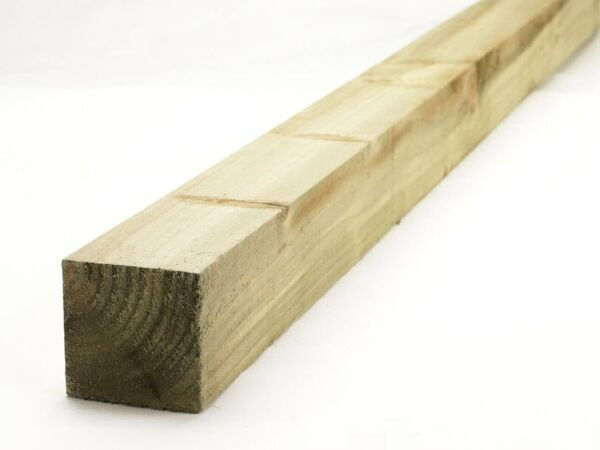
Posts are the backbone of the fence and the most consequential thing to get right. Undersized or undertreated posts will fail at ground level within a few years.
Standard spec for featheredge work is green treated to UC4 - that's the treatment class specifically rated for ground contact. Post length depends on finished fence height:
The rule of thumb is roughly one third of post length in the ground, though this varies with ground conditions.
Youngs manufacture notched posts in-house at our Biddenden branch - a practical alternative to traditional morticed posts. Instead of having to cut mortices and tenon your rails, the posts come pre-notched to accept standard rails directly. You slot the rails in, fix them off, and you're boarding up. No morticing or tenoning, and less time spent on each bay.
2. Arris Rails

Arris rails are the horizontal timbers that span between posts and carry the featheredge boards.
For a 1.8m high fence, use 3 rails - top, middle and bottom. Two rails is sometimes used on lower fences but for anything at full height, three rails is the right call for rigidity and board support.

3. Gravel Boards
Gravel boards sit horizontally at the base of the fence between posts, just above ground level.
They protect the bottom of your featheredge boards from soil, moisture and grass contact - which is where most board rot starts.
Don't skip them. They extend the life of the whole fence and give a cleaner finish at the base.
4. Featheredge Boards
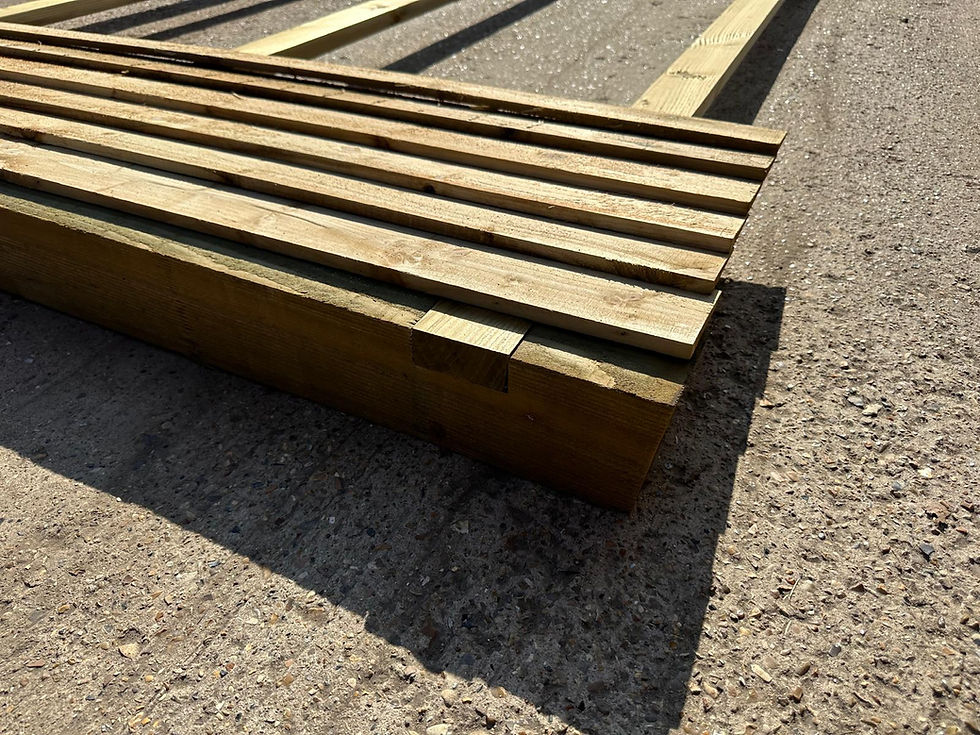
Featheredge boards are sawn softwood with a tapered profile - thick on one edge, thin on the other. They're fixed vertically, overlapping each other by around 20–25mm, thick edge over thin edge, all the way across each bay.
How to Build It Right
Step 1 — Set Your Posts
Mark out your post positions at 2400mm centres. Dig or bore to a minimum depth of 600mm for a 1.8m fence - deeper in loose or sandy ground. Check posts for plumb and align the faces in a straight line before filling. Postcrete or a concrete mix to ground level; allow to cure before loading the fence.
If using our in-house notched posts, check that the notches face the correct direction - towards the field side of the fence - before they go in the ground.
Step 2 — Fit the Gravel Boards
Fix gravel boards between posts at the base, sitting just clear of the ground. They should be level and well-supported. Gravel board brackets or cleats fixed to the posts are the standard method.
Step 3 — Slot in the Rails
With notched posts, this is straightforward - drop your arris rails into the notches. Check they're level, then fix with galvanised nails or screws at each notch. Start at the top rail and work down.
If using morticed posts, rails should be tenoned to fit - or cut to length with a weathered top profile to shed water if left stub-ended.
Step 4 — Fit the Featheredge Boards
Start at one end of each bay. Fix the first board vertically, thick edge facing out (away from your side), using galvanised ring shank nails or equivalent. Two fixings per rail.
Overlap each subsequent board by 20–25mm - thick edge over thin. Use a batten offcut as a spacing guide to keep your overlap consistent across the run. Check plumb every few boards.
The last board in each bay often needs trimming to width. Cut with the thick edge intact where possible - it's the structural face.
Step 5 — Cap and Finish
Fit a timber capping rail or arris rail cap along the top of the boards to shed water and give a tidy finish. This also helps hold the tops of the boards in line. Apply end grain preservative to any cut ends.
Get Everything You Need at Youngs
We stock the full range of featheredge fencing components across our Folkestone, Dymchurch and Biddenden branches - and our notched posts are made in-house at Biddenden, available for collection or delivery.
If you need help working out quantities for a specific job, our trade counter staff are happy to run the numbers with you.
→ View our fencing range: doityoungs.com/fencing
→ Read more about our in-house notched posts: Build Fences Faster with Notched Posts


